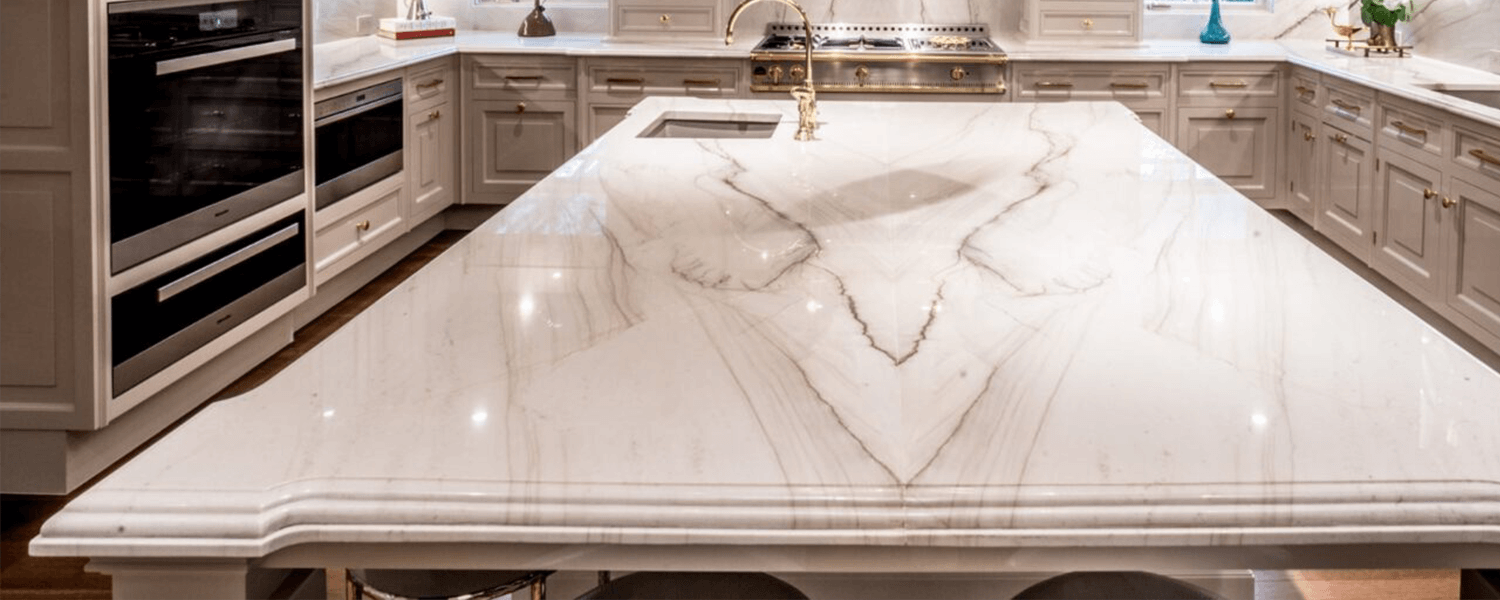
A natural stone slab anchors a room with a kind of beauty no factory can replicate. Choosing its edge profile is an important decision, as this single detail shapes how a slab reads in a room. Whether it’s for a Calacatta marble slab or a dense, crystalline quartzite, selecting the right edge honors the material’s natural character.
When designers, architects and homeowners learn which edge profile works for their project, they transform a remarkable slab into a statement. Discover the distinct edge profiles and how to choose the right one for your space.
What Are Countertop Edge Profiles?
An edge profile is the shape a raw slab forms when fabricators cut or grind along a countertop’s exposed side. These profiles are separate from a stone’s surface finish, which can be polished, honed or leathered. The edge profile also differs from the slab’s veining, which are the unique lines that run through the material.
You will finalize the edge profile during the procurement or design stage, before installation begins. Though it might feel like a small design decision, it echoes throughout the piece, as it influences the:
- Overall design style.
- Safety around corners.
- Visual thickness of the countertop.
6 Types of Edge Profiles
Edge profiles for natural stone carry their own personalities, uniquely contributing to a space’s style. Here are six popular options and where each one shines.
1. Eased Edge
An eased-edge countertop features softened square corners. This edge is essentially a flat, straight edge with just enough rounding to remove any sharpness. With its unobtrusive profile, it highlights the stone’s natural beauty and bold veining while maximizing the slab’s visual thickness.
- Design profile: Modern, contemporary, minimalist, transitional
- Best stones: Granite, quartzite, marble
- Family-friendly rating: Good
2. Pencil Edge
A pencil edge features a narrow, gently rounded curve that mimics the tip of a pencil. Striking a balance, it softens sharp lines without a dramatic curve, making it ideal for transitional kitchens that blend old and new elements.
- Design profile: Transitional, traditional, farmhouse, cottage
- Best stones: Granite, quartzite, marble
- Family-friendly rating: Very good
3. Beveled Edge
A beveled edge is a sloped cut across the upper surface of the slab, creating a chamfered look. The angled surface reflects light brilliantly and adds geometric depth, making it a popular choice for kitchen islands that serve as a room’s focal point.
- Design profile: Modern, contemporary, art deco, transitional
- Best stones: Granite, quartzite
- Family-friendly rating: Good
4. Half-Bullnose Edge
A half-bullnose profile rounds the top edge fully while keeping the bottom flat and square. This versatile shape softens a countertop’s look without eliminating all structure, reading as approachable and clean.
- Design profile: Traditional, transitional, coastal, cottage
- Best stones: Granite, quartzite, marble
- Family-friendly rating: Very good
5. Full-Bullnose Edge
A full bullnose rounds the edge completely from top to bottom, forming a smooth half-circle. Because the shape eliminates sharp angles, it’s a good choice for households with children where safety is a priority. By giving countertops a softer, more refined look, a full-bullnose edge can make a space feel more intimate and welcoming.
- Design profile: Traditional, country, Mediterranean, cottage
- Best stones: Granite, quartzite, marble
- Family-friendly rating: Excellent
6. Mitered Edge
This profile joins two pieces at a 45-degree angle, creating the illusion of a much thicker slab that signals permanence and high-end craftsmanship. It works especially well with stones that have dramatic linear veining, since fabricators can match the veining so it flows continuously around the edge.
- Design profile: Contemporary, minimalist, modern, luxury
- Best stones: Granite, quartzite, marble
- Family-friendly rating: Good
Finding the Right Edge for Your Space
When selecting an edge profile, consider the three factors below to ensure your choice holds up long after installation.
1. Your Design Style
Edge profiles carry their own visual language. They communicate geometry, weight and ornamentation, and that language either reinforces or competes with a space’s design. A sharp, linear edge signals modernity and restraint, while a curved, layered profile connotes warmth and tradition. Achieving this harmony between an edge’s visual language and a space’s design makes an installation feel considered rather than assembled.
To guide this selection, certain edge profiles work exceptionally well with specific design styles:
- Modern/contemporary: Eased, pencil, beveled, mitered
- Transitional: Pencil, bevel, half bullnose
- Traditional: Full bullnose
- Luxury: Mitered
2. Your Stone
Different natural stones have varying hardness ratings, and that hardness affects which edge profiles look best. Denser stones can hold fine, crisp details and pair well with profiles featuring sharp lines, while other stones shine with simpler, rounded shapes. Consider which edge profiles work best with granite, quartzite and marble:
- Granite: This versatile and dense natural stone complements any edge profile. A beveled-edge profile on darker granite countertops works especially well, as the angle catches light dramatically.
- Quartzite: To create edges, this exceptionally dense stone requires dedicated fabrication tooling. Eased and beveled profiles look razor-sharp on quartzite countertops, and more elaborate options like a mitered edge stand out beautifully.
- Marble: Elegance comes through best on marble when edge profiles let veining take center stage. Eased, pencil and bullnose edge profiles on marble countertops soften the look without competing with the stone’s natural movement.
3. How the Space Is Used
Practicality matters as much as style. Consider how the space around the countertop actually gets used day to day, since the busiest surfaces in a home deserve a different approach than a quiet accent area:
- Homes with children: Rounded profiles like full bullnose, half bullnose or eased edge soften sharp corners and reduce the risk of bumps and bruises.
- High-traffic areas: Kitchen islands and other frequently used surfaces hold up best with profiles that avoid fragile, pointed geometry. The National Kitchen & Bath Association also recommends clipped or round corners rather than sharp edges for these spaces.
- Statement pieces: Feature islands and low-traffic vanities are ideal spots for a more sculptural profile, like a mitered edge.
Discover One-Of-A-Kind Natural Stone Slabs
The right edge profile starts with the right slab, and Stone Boutique is known for sourcing rare, once-in-a-lifetime natural stone that’s hard to find anywhere else. Every slab in our collection carries its own veining and character, ready to be paired with the profile that suits your space.
Before you commit to a stone or profile, explore your natural stone options in our digital gallery. Our visualization room and 3D rendering technology let you see exactly how your chosen slab and edge will come together, down to how the profile frames the finished space, before a single cut is made.
Ready to see your project take shape? Book an appointment with our team today.